
Pharma R&D faces a substantial challenge of decreasing returns on committed investment. Read the following sections on why pharma executives are struggling with R&D productivity. The content will help you to
Across pharmaceutical organizations, performance challenges rarely appear as isolated issues. Instead, they are typically the visible result of underlying structural dynamics within the R&D system.
In practice, these challenges fall into two categories:
In many organizations, the root cause is not a lack of ideas, but a lack of focus. Early-stage portfolios are often spread too broadly across targets, indications, and modalities, diluting resources and attention from the outset.
As a result, too many assets are progressed in parallel without sufficient depth, clear prioritization, or consistent strategic direction. Promising opportunities are not developed with the required rigor, while weaker ones remain in the system for too long. The consequence is a pipeline that appears active but lacks the focus, quality, and reliability required to sustainably drive future growth.
Despite significant and often increasing R&D investment, productivity often remains below expectations. Development timelines extend, assets stall, and resources are deployed without
proportional output.
A key driver is not a lack of effort or funding, but weak portfolio discipline and decision clarity, reinforced by growing transformation fatigue. Too many initiatives are launched in parallel, decision criteria shift over time, and stop decisions are delayed, leading to reduced focus, declining engagement, and diluted impact across the pipeline.
Clinical development has become significantly more complex, with more demanding protocols, higher data requirements, and increasing coordination effort across global teams and partners.
Delays in trial start-up, recruitment challenges, limited risk visibility, and high coordination effort lead to inefficiencies. While individual issues may appear manageable, their cumulative effect leads to major delays, rising costs, and loss of momentum.
Although many organizations have invested heavily in digital tools and analytical capabilities, their impact on R&D decisions often remains limited. Data is spread across systems, analytical outputs are not consistently reused, and insights arrive too late to influence portfolio and execution decisions.
While pockets of computational innovation exist, they often remain localized and difficult to scale. As a result, decision quality suffers, and advanced analytics fail to translate into sustained, system-wide impact.
Most organizations attempt to address R&D challenges through isolated initiatives – new tools, optimized processes, or transformation programs. While these efforts can deliver local improvements, they rarely resolve the underlying system dynamics. The Pipeline Success Engine takes a different approach.
Rather than adding another layer of processes, it establishes a fundamentally different way of working across R&D. At its core lies a simple idea: Sustainable acceleration does not come from more activity – it comes from creating the conditions that allow people to consistently turn ideas into impact.
By reducing friction, creating clarity on priorities and readiness, and making progress visible, the Pipeline Success Engine reshapes how ideas, decisions, and execution interact across the organization.
The Pipeline Success Engine is not a traditional transformation program. It enables organizations to shift into an intrapreneurial state of mind – where progress is driven from within, not pushed from the outside.
In this environment, teams take ownership within clearly defined goals, contribute ideas early, and act with clarity based on shared expectations and evidence. At the same time, they continuously improve how work gets done. This shift directly addresses the core challenges in R&D: strengthening the inflow of high-quality, investable ideas and enabling faster, more predictable progression through the pipeline.
With these conditions in place, improvement becomes part of everyday work – not an isolated initiative.
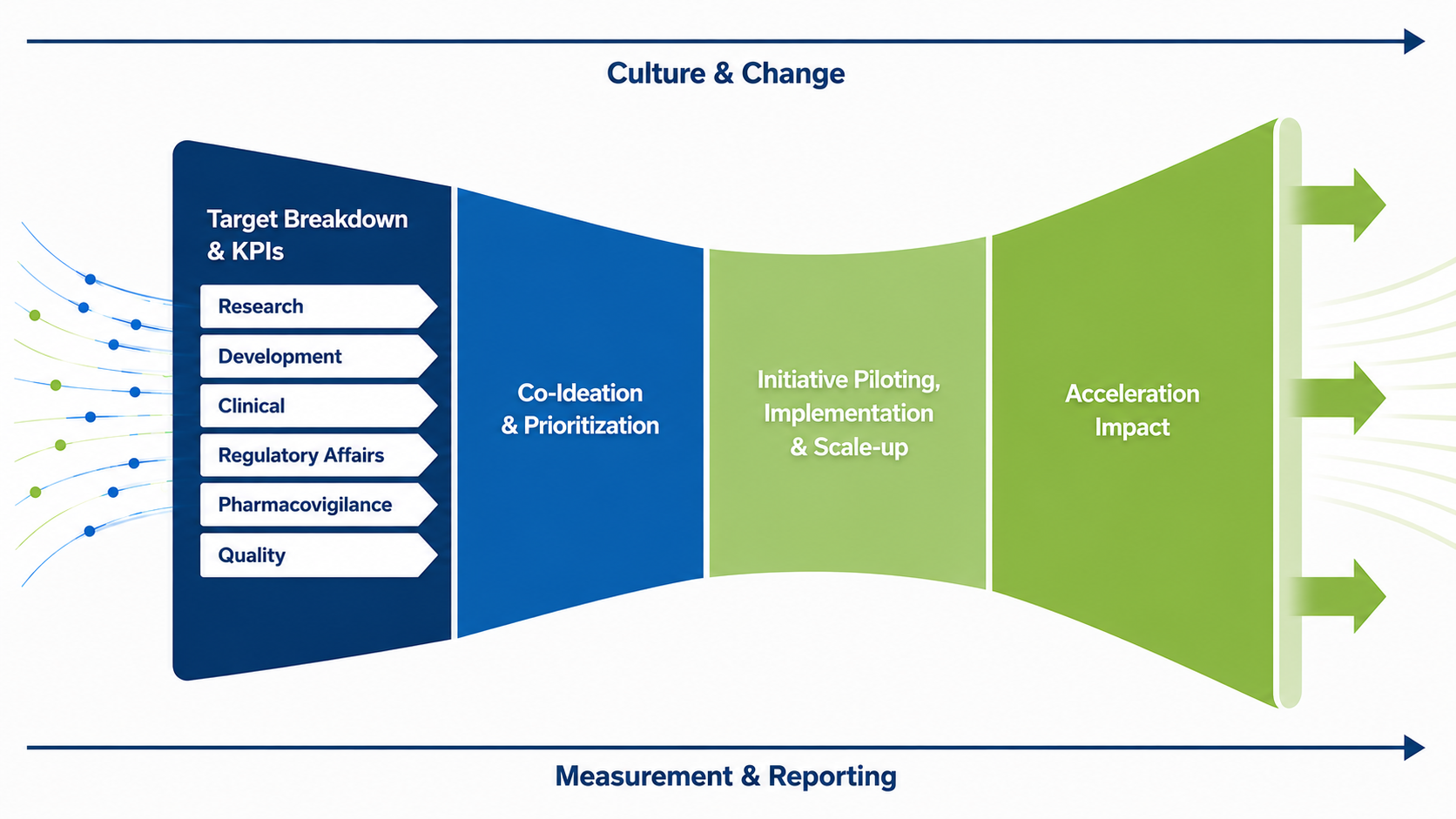
At its core, the Pipeline Success Engine connects two essential elements: the generation of high-impact initiatives and the ability to implement, scale, and sustain them across the organization.
This reflects a key principle:
Good ideas alone do not improve pipeline performance – their adoption and consistent execution do.
To enable this, the Pipeline Success Engine combines two tightly connected layers. The “interior” translates strategic and functional targets into prioritized, actionable initiatives. The “exterior” creates the environment required to activate teams, drive execution, and sustain impact – through transparency, routines, and clear ownership.
Together, these elements ensure that initiatives are not only identified but also consistently implemented and embedded across the organization.
A structured space in which ideas can emerge early across the R&D value chain – without immediate implementation pressure. Ideas are shaped and prioritized based on feasibility, strategic relevance, and expected impact.
An environment that enables people to engage, take ownership, and move ideas forward. Early visible progress, simple routines, and shared orientation reduce hesitation and create momentum.
A shared view on priorities, progress, and impact that makes development visible, surfaces risks early, and enables faster, better-aligned decisions across functions.
A key differentiator of the Pipeline Success Engine lies in how change is activated. Rather than relying on large-scale transformation programs, the approach focuses on creating early, visible progress. Initial initiatives demonstrate that improvement is possible within the existing organization, building confidence and reducing skepticism.
As more teams begin to contribute and take ownership, this dynamic becomes self-reinforcing. Over time, improvement is no longer driven by external push – it becomes part of how R&D operates on a daily basis.
Organizations that adopt this way of working typically establish more stable and predictable R&D performance, driven by continuous contribution from within the system.
In practice, this translates into a stronger and more reliable pipeline inflow, with more high-quality and better-prepared ideas entering early stages. At the same time, execution becomes faster and more predictable, as decisions are made earlier, risks become visible sooner, and friction across interfaces is reduced.
Beyond these performance effects, a third impact becomes visible: sustainable organizational activation. Teams take ownership, improvements continue beyond initial initiatives, and change becomes embedded in everyday routines – strengthening the organization’s ability to continuously improve itself.
Turning this way of working into tangible results requires more than a conceptual framework. It requires a deep understanding of pharmaceutical R&D, the ability to identify high-impact levers, and experience in translating ideas into operational reality.
This is where Santiago Advisors supports organizations – from initial activation to sustainable implementation at scale.
While the Pipeline Success Engine provides the structural foundation for accelerating R&D, its impact depends on how it is applied in practice.
We therefore follow a pragmatic, results-oriented approach focused on reducing friction, enabling action, and making progress visible – ensuring that initiatives are not only defined but also take root, scale, and deliver lasting results.
We work side-by-side with your teams as trusted advisors, sharing responsibility for outcomes rather than acting as external observers. By combining our industry expertise with internal knowledge, we co-create solutions that are both strategically sound and operationally feasible.
Rather than launching large-scale transformation programs upfront, we start with targeted, high-impact pilots. These create early, visible progress and demonstrate tangible value in selected areas.
We ensure that initiatives do not remain conceptual but are translated into operational reality. This includes strong emphasis on implementation readiness, stakeholder alignment, and effective governance in practice.
Throughout the process, we link initiatives to concrete KPIs and track progress continuously — ensuring transparency, accountability, and sustained momentum over time.
The client faced low innovation momentum and a widespread belief that no further acceleration potential existed. Previous ideation efforts produced few viable ideas, while functional silos limited visibility and initiatives repeatedly stalled. This led to growing skepticism and low engagement. Many employees felt their ideas were not heard or taken forward, reinforcing the perception that contributing would not make a difference.
We combined grassroots activation to unlock intrapreneurship with structured mechanisms from the Pipeline Success Engine. By mobilizing employees bottom-up and creating ownership across functions, ideas were systematically identified, shaped, and prioritized.
Statistical reporting was highly manual, fragmented across systems, and dependent on a few experts. This led to long turnaround times, high error risk, and inconsistent outputs.
Santiago implemented an AI-powered multi-agent system, including a Statistical Author and Quality Control Agent, fully integrated into the existing R/SAS environment. The solution automated end-to-end reporting workflows while ensuring consistency and compliance.
We are a specialized consulting firm supporting organizations in the life sciences and chemical industries. Since 2008, we have helped clients translate scientific potential into measurable business outcomes.
Our work spans the full value chain, with a strong focus on R&D — from early research to development and portfolio management. We partner with leaders across functions to strengthen portfolio quality, accelerate development, and improve decision-making.
Our approach combines strategic perspective with hands-on implementation. We work closely with our clients to ensure that initiatives are not only defined but also translated into tangible and lasting results.
Our team consists of around 60 experienced consultants and senior advisors with diverse scientific, strategic, and operational backgrounds. Over the past years, we have supported more than 330 projects across strategy, transformation, and operational excellence.
This combination allows us to bridge the gap between strategic ambition and operational reality — helping organizations turn ideas into sustainable performance improvements.
Schedule your free initial consultation and share your contact details with us.
We will get back to you, gain a first understanding of your situation, and arrange a dedicated strategy session.
In this session, we will discuss all relevant details and answer your questions regarding a potential collaboration.